
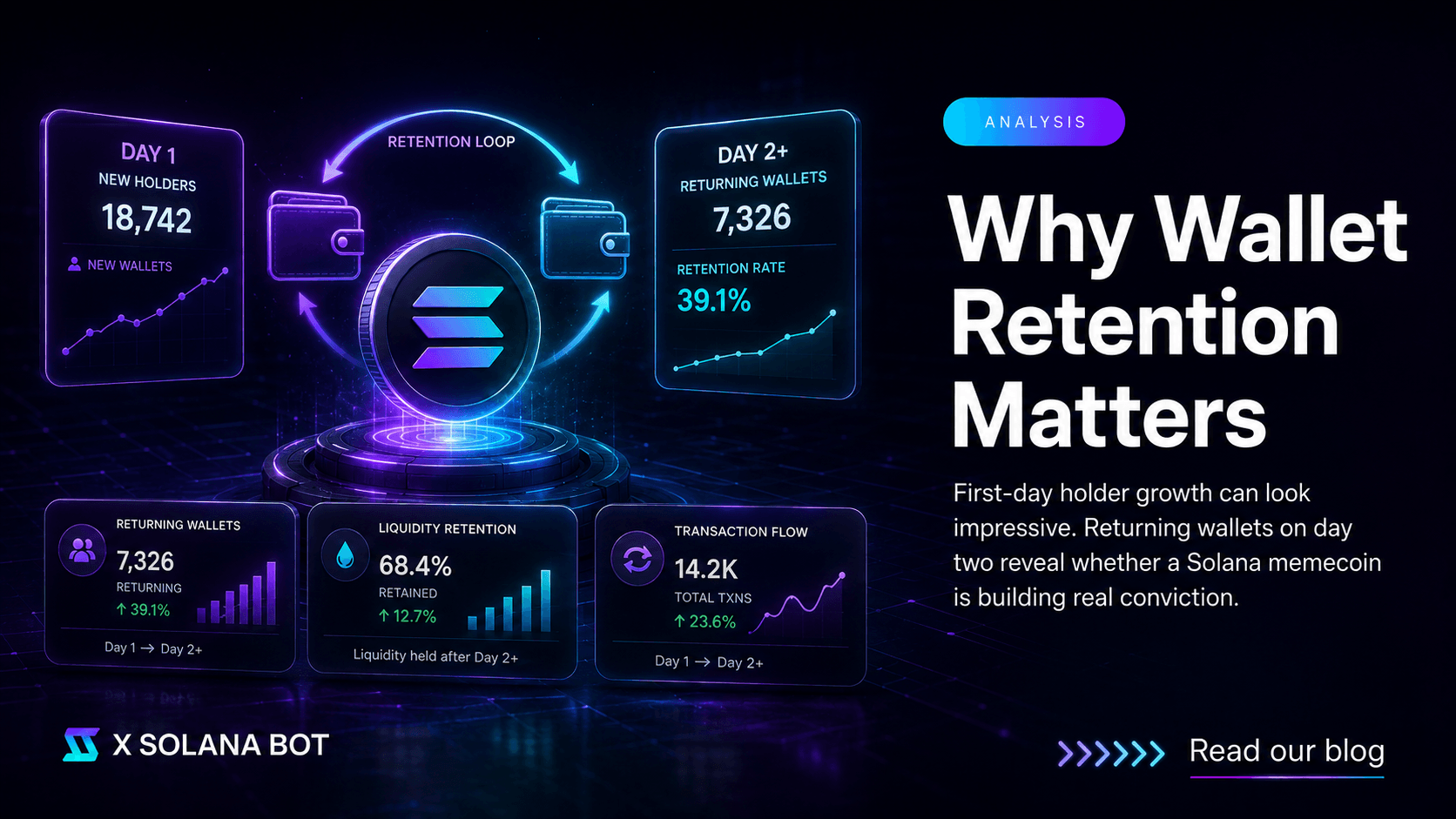
In the Solana memecoin market, first-day metrics often receive the most attention. Traders look at holder growth, volume spikes and early wallet activity to decide whether a token is gaining momentum. These signals can be useful, but they do not tell the full story. A token may attract a large number of wallets at launch and still fail to build any real staying power. This is why wallet retention matters. Returning wallets, continued participation and repeat activity can reveal whether a memecoin is building real conviction or simply benefiting from launch-day excitement.
Why first-day holder growth can be misleading
One of the most common metrics used in memecoin analysis is holder growth. At first glance, this makes sense. A rising number of wallets suggests expanding interest and wider distribution. When a new token launches on Solana and quickly gains thousands of holders, the market often interprets this as a bullish sign.
The problem is that launch-day activity can be heavily influenced by temporary forces. Traders are drawn to novelty, aggressive early movement and the fear of missing out. A token may gain a large number of first-day wallets because participants want exposure to the launch itself, not because they have any long-term interest in the token.
This creates a structural weakness in the metric. Holder growth measures entry. It does not measure persistence.
A token that attracts ten thousand wallets on day one but loses most meaningful activity immediately afterward may look strong on paper while remaining fragile in practice.
What wallet retention actually shows
Wallet retention adds an important second layer to the analysis. Instead of focusing only on how many wallets interacted with the token initially, retention asks a more revealing question: how many came back?
This shift is important because repeat participation reflects a different kind of market behavior. A first interaction may be driven by curiosity or momentum. A second interaction suggests continued interest. When wallets return after the launch phase, it often means the token is doing more than generating a short-lived spike.
Retention is therefore not just a technical metric. It is a behavioral signal.
It helps distinguish between one-time attention and recurring engagement. In a market where many tokens can attract a first wave of activity, the ability to keep wallets involved becomes a much more meaningful sign of quality.
Why day-two wallet behavior matters
The period after launch is where many memecoins begin to separate from each other. During the first day, almost every active token can look stronger than it really is. Liquidity is fresh, transaction flow is concentrated, and social attention is at its highest.
By the second day, the environment becomes more revealing. Early traders start taking profit. Casual buyers move on. New launches compete for attention. The token is no longer supported by novelty alone.
This is where returning wallets matter most.
If wallets continue interacting with the token after the initial rush, the project may be building real participation. If the wallet base disappears almost immediately, the first-day growth may have been little more than temporary traffic.
Day-two retention is especially useful because it helps filter out launch noise. It does not guarantee quality, but it creates a stronger signal than launch-day holder count alone.
Retention and liquidity stability
Wallet retention also matters because it often connects to liquidity quality. A token that maintains returning participation is more likely to retain a healthier trading environment. Repeat users help sustain transaction flow, support market depth and reduce the risk of complete inactivity once early hype fades.
By contrast, weak retention often leaves liquidity exposed. If most wallets only appear once, the token may struggle to maintain organic trading interest. Liquidity can remain visible, but the market underneath it becomes thinner and less reliable.
This is why liquidity should not be analysed in isolation. Stable liquidity becomes more meaningful when it is supported by returning participation. When the same token shows both liquidity retention and wallet retention, the market structure often looks more durable.
Why transaction flow matters alongside retention
Retention should also be interpreted together with transaction activity. A token may have returning wallets, but the quality of those interactions still matters. Are users coming back in meaningful numbers? Is transaction flow still alive after the launch window? Does the token continue generating engagement beyond the first event?
These questions help place retention in context.
A strong retention profile usually includes several related elements:
- wallets continuing to interact beyond day one,
- transaction flow remaining active,
- liquidity holding reasonably well,
- and the token avoiding a complete collapse in participation.
The goal is not to search for perfection. The goal is to identify whether the token still behaves like an active market once the easiest attention has already passed.
Retention reveals conviction more than hype
Hype and conviction are not the same thing.
Hype brings people in quickly. Conviction keeps some of them involved after the excitement fades. This distinction is essential in memecoin analysis because the market is full of projects that know how to attract attention but very few that maintain any meaningful participation beyond the first cycle.
Wallet retention gives traders a way to observe this difference in a more structured way. A token with weak retention may still create short-term moves, but it is less likely to demonstrate sustained relevance. A token with stronger retention may show that participants are continuing to monitor, trade and support the market beyond the launch event itself.
For this reason, retention can act as a measure of market seriousness, even in a speculative environment.
How analytical platforms can use retention data
For a tool such as XSolanaBot, wallet retention can become a very powerful part of token intelligence. Most platforms already show launch data, holder counts and transaction activity. The next step is to preserve that information over time and compare it with what happens afterward.
A stronger analytical model might show:
- first-day new wallets,
- day-two and day-three returning wallets,
- retention percentage,
- liquidity retention,
- and continued transaction activity.
This kind of framework makes the platform more useful because it moves beyond simple discovery. It helps traders understand whether the token remained relevant after discovery.
Instead of only asking whether a token had a strong launch, users can ask whether the wallet base held together after the first emotional wave. That is a much more informative question.
Final thoughts
In the Solana memecoin market, holder growth will always attract attention. It is easy to see, easy to compare and easy to celebrate. But it is not enough on its own.
A token’s real quality often becomes clearer only after the first rush has passed.
That is why wallet retention matters.
Returning wallets, continued interaction and repeat activity reveal whether the market still has interest once the launch buzz is gone. Retention does not replace holder growth, but it gives it context. It helps separate visibility from conviction and launch excitement from sustained participation.
For traders, that distinction matters.
Because in memecoin analysis, it is not only important to know who arrived first.
It is just as important to know who came back.