
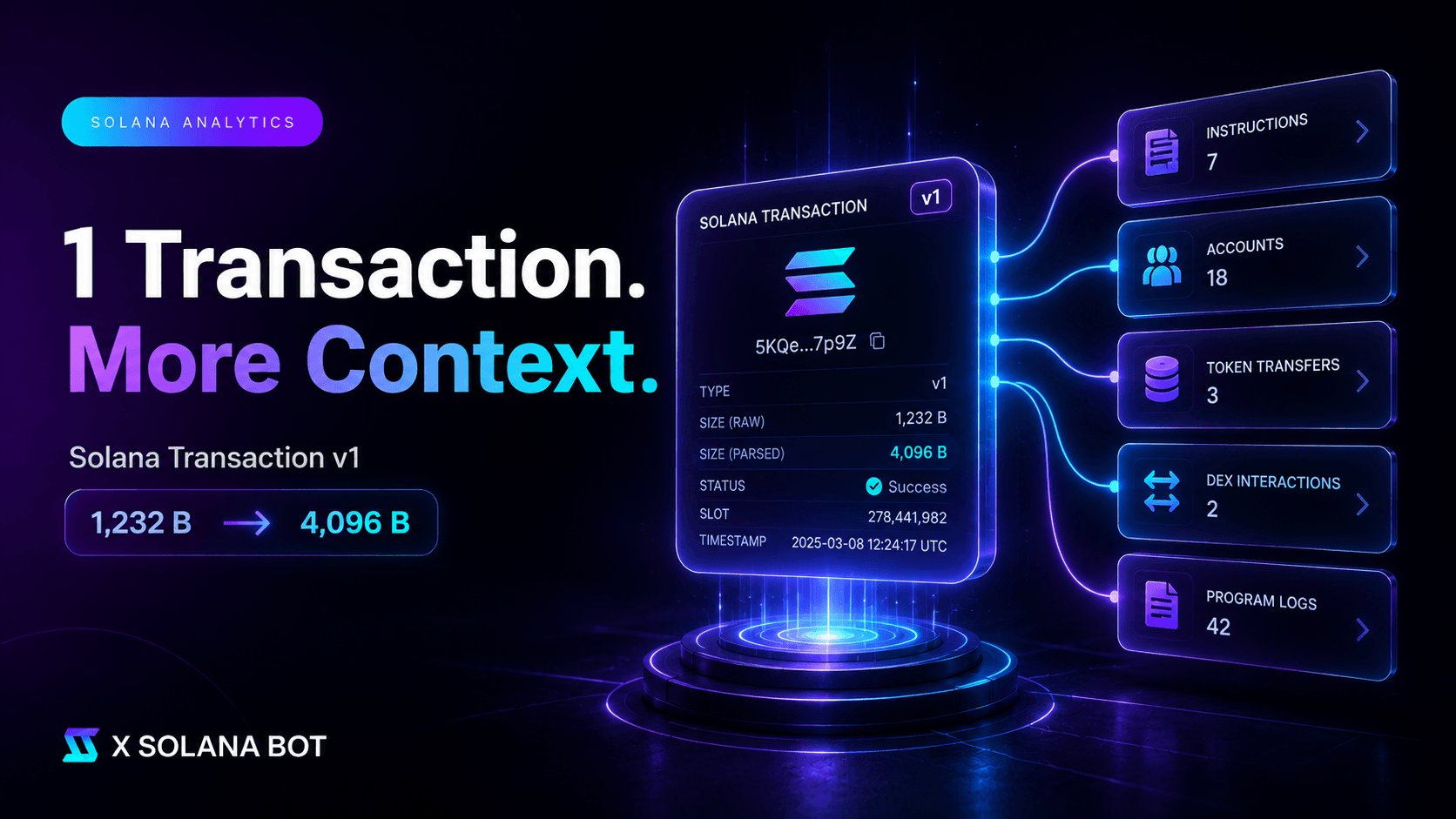
Solana’s Transaction v1 format represents a significant change in how activity can be packaged on-chain. With the maximum transaction size increasing from 1,232 bytes to 4,096 bytes, applications can place substantially more data and complexity inside a single atomic transaction. For Solana memecoin analytics, this matters because many popular market metrics still treat transactions as simple, comparable units of activity. As the transaction format evolves, analytical platforms need to understand not only how many transactions occur, but what those transactions actually contain.
Solana Transaction v1 changes the basic transaction envelope
For years, Solana transactions operated under a strict 1,232-byte size constraint inherited from the network’s packet architecture. That limit influenced how developers structured swaps, multisig operations, cryptographic proofs and more complex interactions.
Transaction v1 changes that constraint substantially.
The maximum transaction size is now 4,096 bytes, giving applications more than three times as much room inside a single transaction. Legacy and v0 transactions continue to function, so the network now supports activity created under different transaction formats at the same time.
For application developers, the benefit is straightforward: operations that previously required splitting logic across multiple transactions may now fit into a single atomic execution.
For analysts, however, the change creates a different question.
What exactly does a transaction represent?
Transaction count has never been the same as user activity
Even before Transaction v1, raw transaction counts had limitations.
One person can generate many transactions. Bots can execute hundreds or thousands of operations. A single trading strategy can interact with several protocols. Automated routing systems can generate activity that looks very different from organic retail participation.
This means that 100,000 transactions never automatically represented 100,000 traders or 100,000 independent decisions.
Transaction v1 makes this distinction even more important.
When more instructions, signatures and application logic can fit inside one transaction, two transactions can contain radically different amounts of meaningful activity.
Counting them equally may therefore hide important differences.
One transaction can represent a more complex economic action
Consider a very simple token purchase.
A wallet interacts with a liquidity pool, exchanges one asset for another and receives the purchased token.
Now compare that with a more complex transaction involving additional accounts, routing logic, multiple program interactions or cryptographic operations.
A transaction counter sees:
one transaction,
and one transaction.
From an analytical perspective, those events are not necessarily equivalent.
The economic behaviour inside the transaction matters.
This is why modern Solana analytics increasingly needs to operate at the instruction and account-interaction level rather than relying only on transaction totals.
Why this matters for Solana memecoin scanners
Memecoin scanners commonly display metrics such as transaction count, number of buys, number of sells and transaction velocity.
These indicators are useful because they provide a quick picture of activity.
But they can also create false simplicity.
A rapidly increasing transaction count may indicate broad participation. It may also reflect automation, routing behaviour or repeated activity from a relatively small number of wallets.
Transaction v1 adds another layer: a more capable transaction format means meaningful activity can be packaged differently than before.
For an analytical tool such as XSolanaBot, the question therefore needs to move beyond:
How many transactions occurred?
toward:
What kind of activity did those transactions represent?
Instruction-level analysis becomes more important
Every Solana transaction contains instructions telling programs what operations to execute.
For memecoin analytics, those instructions can reveal considerably more than the transaction signature alone.
They help identify whether activity represents a swap, transfer, liquidity operation or interaction with another protocol.
When several instructions occur within the same transaction, analysing them separately can provide a much more accurate understanding of what happened.
This is especially useful for identifying complex trading routes.
A user may initiate what appears to be one action while the underlying transaction interacts with several programs before arriving at its final outcome.
From the user’s perspective, it was one trade.
From the blockchain’s perspective, it may contain multiple layers of execution.
A sophisticated analytics platform needs to reconstruct that story.
Wallet-level context remains essential
Transaction complexity does not remove the importance of wallet analysis.
In fact, it makes wallet context even more valuable.
Suppose a token suddenly shows increasing transaction activity. Analysts still need to know whether the activity comes from hundreds of independent wallets or a small group of highly active addresses.
The transaction format cannot answer that question alone.
Wallet history, funding relationships, transaction timing and repeated behavioural patterns remain necessary to understand the market structure.
This is why transaction analysis and wallet analysis should not operate as separate systems.
They describe different parts of the same event.
Transaction v1 also changes how some fee information is represented
Transaction v1 is not simply a larger container.
It also restructures parts of the transaction message.
For example, resource limits and priority-fee configuration are represented differently from legacy and v0 transactions. In v1, priority fees are specified directly in message configuration rather than through the older Compute Budget instruction pattern.
This is primarily a developer-level implementation detail, but it has analytical consequences.
Services that decode Solana activity need to understand the transaction format correctly. A parser built around assumptions from older transaction versions can misunderstand or fail to expose important information when processing v1 activity.
For traders, the interface may look unchanged.
For analytics infrastructure, the underlying data model has changed.
Accurate parsing becomes part of analytical quality
This creates a new distinction between analytics platforms.
Two services may ingest exactly the same blockchain.
One correctly understands legacy, v0 and v1 transactions.
The other was designed around previous formats and fails to interpret newer activity consistently.
Both may still display charts.
Both may still report transaction counts.
But the quality of the underlying data can differ.
For advanced memecoin analytics, infrastructure quality therefore matters.
The usefulness of an indicator depends on whether the platform correctly understands the raw blockchain events used to construct it.
Larger transactions do not mean unlimited transactions
The move to 4,096 bytes should not be interpreted as removing Solana’s other constraints.
Transaction v1 provides more space for transaction data, but compute limits and account constraints still exist. Solana continues to enforce limits on how much computational work one transaction can perform.
This distinction matters because the upgrade increases flexibility without turning a single transaction into an unlimited execution environment.
The practical effect is more room for richer atomic operations, not infinite complexity.
For analysts, this means that transaction size is another contextual variable rather than a simple measure of economic significance.
Transaction size itself can become an analytical feature
Once different transaction sizes are common, size distribution may become useful context.
A token whose activity consists primarily of small, simple transactions can have a different market structure from one where a substantial portion of activity involves larger, more complex transactions.
This does not make either structure automatically stronger or weaker.
But it can help classify the type of activity surrounding a token.
Analytics can examine:
the distribution of transaction sizes,
the number of instructions per transaction,
the programs involved,
the number of interacting accounts,
and the economic outcome of the transaction.
Together, these features provide a richer picture than transaction count alone.
Activity needs to be normalized by behaviour
A major challenge in blockchain analytics is comparing activity fairly.
If one token generates 10,000 simple transactions while another generates 5,000 more complex operations, comparing only transaction totals may produce the wrong conclusion.
A better analytical model groups activity according to its behaviour.
How many unique wallets participated?
How many independent swaps occurred?
How much real volume moved?
How often did the same wallets repeat similar actions?
How much liquidity was involved?
Did activity persist?
These measures help analysts move from blockchain-level counts toward market-level interpretation.
Why historical comparisons may need additional context
Transaction v1 also creates a subtle issue for historical analytics.
A dashboard may compare today’s transaction activity with data from several months ago.
But if the way applications package activity changes over time, the raw number of transactions may no longer be perfectly comparable.
This is common in technology-driven markets.
When infrastructure evolves, analytical baselines sometimes need to evolve with it.
The solution is not to stop using historical data.
It is to understand when protocol changes alter the meaning of a metric.
This is another reason why contextual analytics matter.
What XSolanaBot can do differently
For XSolanaBot, Transaction v1 provides an opportunity to deepen transaction intelligence.
Instead of treating every transaction as an identical unit, the platform can classify what happened inside each transaction.
A token profile can combine transaction count with unique wallets, instruction type, activity persistence, liquidity interaction and behavioural patterns.
This allows users to distinguish between:
many simple independent trades,
highly automated activity,
complex routed transactions,
and repeated behaviour from a concentrated wallet group.
The result is not simply more data.
It is a better interpretation of the data already available.
The future of memecoin analytics is contextual
Blockchain explorers were originally designed primarily to show what happened.
Modern trading analytics needs to answer a more difficult question:
What does what happened actually mean?
Transaction v1 makes that distinction especially relevant.
Solana can now package substantially richer operations into one transaction. Analytical systems therefore need to become more aware of transaction structure, application behaviour and market context.
The metric itself is not disappearing.
Transaction count will remain useful.
But it needs to sit beside deeper signals.
Final thoughts
Solana Transaction v1 is a technical upgrade, but its implications extend beyond developers.
Increasing the maximum transaction size from 1,232 to 4,096 bytes changes how much activity can fit inside one atomic transaction and makes transaction structure an even more important part of on-chain analysis.
For memecoin traders, the lesson is simple.
Do not assume every transaction represents the same thing.
Do not assume more transactions automatically mean more independent market participation.
And do not judge activity only by its count.
The blockchain records what happened.
Good analytics explains what it means.