
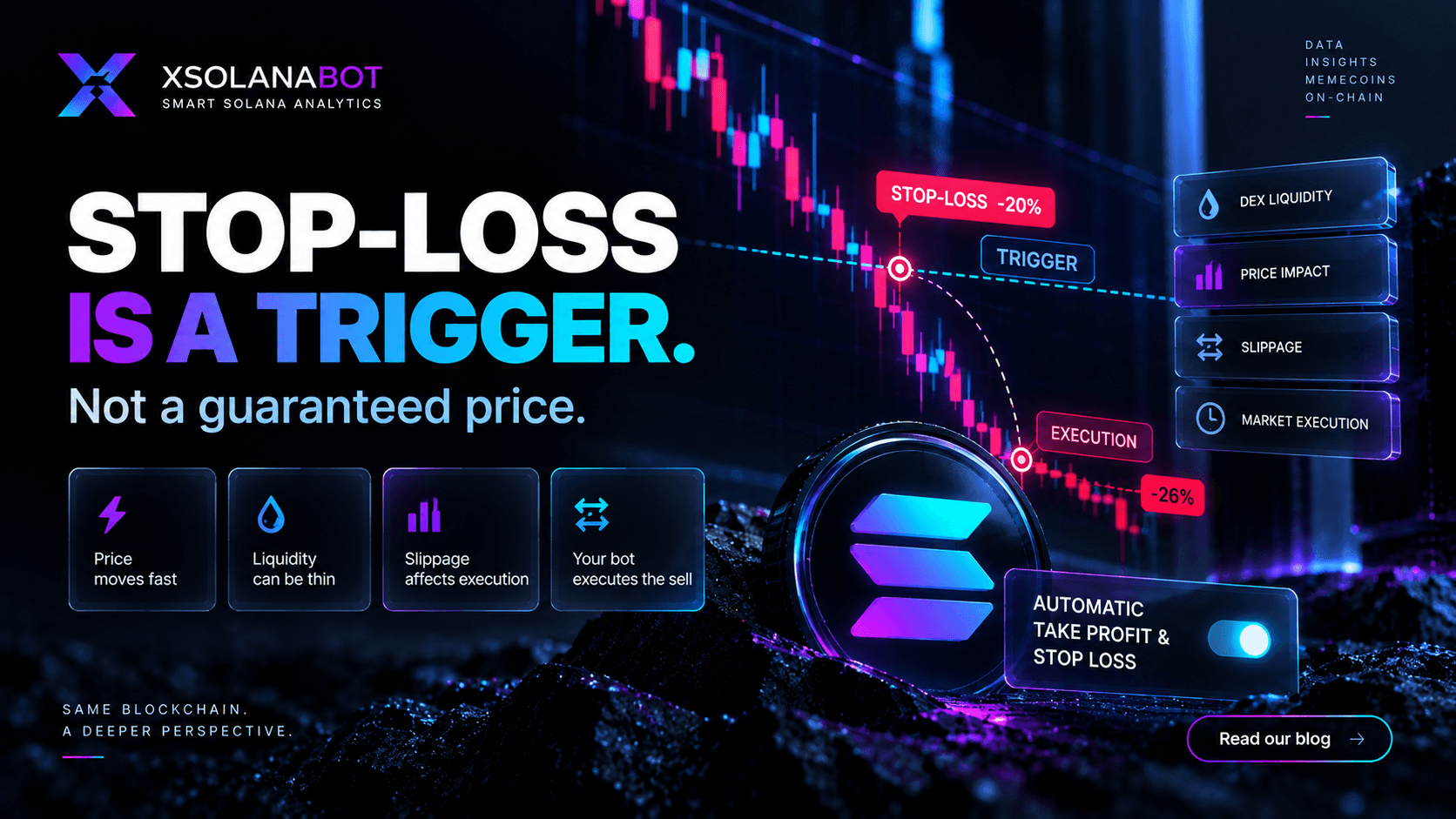
Automated stop-loss orders are among the most useful risk-management features available to Solana memecoin traders. They allow a trading strategy to react when a token reaches a predefined price threshold, even when the trader is not actively monitoring the market. However, a stop-loss trigger should never be confused with a guaranteed execution price. In highly volatile and illiquid memecoin markets, the difference between those two values can be substantial. Understanding slippage, price impact, liquidity and swap execution is essential before relying on automated exits.
How does a stop-loss work when trading Solana memecoins?
A stop-loss is a predefined condition intended to initiate an exit when the market moves against an open position. For example, a trader who purchases a memecoin may decide to close the position if its value falls by 20% from the entry level.
In an automated trading environment, software monitors market conditions and attempts to execute an exit when that condition is satisfied. This removes the need for the trader to watch the chart continuously and can reduce delays associated with manual decision-making.
However, the execution process depends on the underlying trading infrastructure. On decentralized exchanges using automated market makers, conditional trading systems typically rely on external monitoring and transaction execution rather than a conventional resting stop order in a centralized order book.
The sequence involves several separate events: monitoring a reference price, detecting that a threshold has been reached, obtaining or constructing an executable transaction, submitting it and waiting for confirmation.
The stop-loss threshold determines when the exit process begins. It does not determine the final amount the trader will necessarily receive.
That distinction becomes particularly important when trading newly launched Solana memecoins.
The difference between a trigger price and an execution price
The trigger price is the market level selected by the trader to activate the stop-loss condition. The execution price is the actual effective price at which the assets are exchanged if the sell transaction succeeds.
These prices may be close when the market is liquid and relatively stable. In highly volatile markets, however, they can differ significantly.
Imagine a trader purchasing a memecoin with 1 SOL and configuring an automatic exit after a 20% decline in the position's value, measured in SOL.
The stop-loss condition is reached when the displayed position value falls to approximately 0.8 SOL. The automated system then attempts to sell the tokens.
But suppose a large holder is simultaneously exiting, available liquidity is shrinking and several other traders are submitting sells. By the time an executable swap becomes available, the market may offer substantially less than 0.8 SOL for the position.
An eventual receipt of 0.67 SOL would represent an approximate 33% loss in SOL terms rather than the originally intended 20%. This is an illustrative scenario, not a prediction of a particular trade.
The important lesson is that automated execution can reduce the delay between a trading decision and an attempted transaction, but it cannot force a decentralized market to provide liquidity at a specified price.
Why slippage matters during an automated stop-loss
Slippage describes the difference between an expected execution outcome and the result available when a transaction is actually executed. In decentralized trading, it commonly occurs because prices or pool conditions change between obtaining a quote and completing a swap.
A trader might receive a quote indicating that a token sale should return a particular amount of SOL. During the short period before execution, other transactions can change the state of the liquidity pool.
If the trade still executes, the final output may differ from the earlier quote.
Automated trading systems may use slippage tolerances to limit how much deterioration is acceptable. These settings can affect whether a transaction executes under changing market conditions.
A restrictive tolerance offers more protection against an unfavourable swap relative to the quote, but the transaction may fail when the market moves too far.
A permissive tolerance may allow execution during greater volatility, but it also permits a worse outcome relative to the quoted amount.
There is no universally correct slippage setting for every memecoin. The appropriate approach depends on the market, the size of the position, available liquidity and the trader's priorities.
Increasing slippage tolerance should not be mistaken for solving a liquidity problem.
Price impact and slippage are related, but they are not identical
Although the two terms are frequently used together, price impact and slippage describe different aspects of execution.
Price impact is the expected effect that a trade itself can have on market pricing, given the amount being exchanged and the available liquidity. A sufficiently large sell can move the effective execution price against the trader even when no other participant trades during execution.
Slippage concerns the difference between the expected or quoted outcome and the actual execution outcome as conditions change.
A memecoin can therefore present significant price impact before the transaction is submitted. Slippage may introduce additional uncertainty between quotation and execution.
This distinction matters because a trader might configure a relatively tight slippage tolerance and still receive an unattractive quote if the intended sale is large relative to the market's available depth.
In other words, a trading system can execute within its slippage tolerance while the resulting trade still produces substantial losses due to price impact already reflected in the quotation.
A useful risk assessment should consider both factors independently.
Liquidity determines how much a market can absorb
The size of a memecoin position matters relative to the liquidity available for selling it.
Consider two hypothetical tokens. One trades in a relatively deep liquidity pool with substantial available reserves. The other operates in a small pool where comparatively modest transactions can materially alter the price.
A sale of the same nominal size can produce very different outcomes in those two markets.
This becomes especially important during a sharp decline. The liquidity visible when a token is purchased may no longer be available when the stop-loss triggers.
Liquidity providers may withdraw assets where the pool design permits it, large holders may sell aggressively and a series of transactions may rapidly change the pool's composition.
As the market becomes thinner, the cost of executing an exit can increase.
Traders should therefore evaluate the amount they plan to sell relative to the liquidity they can realistically access, rather than relying only on total market capitalization or historical trading volume.
A stop-loss cannot guarantee protection from a liquidity shortage.
Why an automatic sell transaction can fail
An activated stop-loss condition does not necessarily result in a completed sale.
Execution can fail for several reasons, including excessive price movement, insufficient available routing liquidity, expired transaction parameters or temporary infrastructure problems.
In swap systems with a minimum acceptable output, the transaction may be rejected if market conditions deteriorate beyond the allowed tolerance. This prevents execution below the permitted output threshold, but it leaves the trader holding the position.
That outcome creates a difficult trade-off.
The trader has avoided accepting a particular unfavourable execution, but the token may continue falling while the system attempts to obtain a new quote or submit another transaction.
Increasing transaction priority may sometimes improve execution responsiveness under network congestion, but it cannot create missing liquidity or ensure that a particular exchange rate will be available.
It is also important to distinguish between a temporary failed transaction and a token that cannot be sold under normal conditions because of restrictions, asset mechanics or the absence of a viable trading route.
Those risks cannot be solved simply by setting a different stop-loss percentage.
Take Profit and Stop Loss solve different problems
Take Profit and Stop Loss are often presented together because both are forms of conditional exit management.
A Take Profit condition initiates a sale when the market reaches a predefined favourable level. A Stop Loss condition attempts to limit further exposure after an adverse move.
Both can support a more structured trading process.
However, neither one removes execution uncertainty. A Take Profit level can be reached briefly while the effective sale price, available liquidity or routing conditions differ from the trader's expectations.
The distinction is especially relevant in speculative markets where rapid price changes can occur between market-data updates and confirmed transactions.
Automated exit conditions should therefore be understood as tools for implementing a plan rather than guarantees that the final trade will match the plan exactly.
Why measuring profit and loss in SOL can change the result
Many Solana memecoin trades involve purchasing and selling tokens with SOL. This introduces an additional consideration: the reference currency used to evaluate performance.
A position can gain or lose value against SOL while SOL itself changes significantly against the U.S. dollar.
For example, a token might remain relatively stable in SOL terms while its dollar-denominated value falls because SOL declines against USD.
Similarly, a successful exit expressed in SOL does not automatically imply the same percentage result when converted into dollars.
Before interpreting an automated exit, traders should understand whether the system evaluates its trigger using the token's value in SOL, a dollar-denominated reference or another specified pricing method.
For XSolanaBot, the website describes buying Solana tokens with SOL and automatically selling them back into SOL according to configured conditions. Traders should therefore pay attention to the currency basis used when reviewing their positions and actual results.
Position size matters before the stop-loss is activated
One of the most important decisions affecting execution quality is made before the trade begins: choosing the position size.
A small position relative to accessible pool liquidity may have a relatively modest expected price impact. A larger position in the same market can become much more difficult to close efficiently.
This relationship is particularly relevant for memecoins whose liquidity can change sharply during market stress.
Rather than treating the stop-loss percentage as the only risk-control parameter, traders should evaluate the relationship between the capital committed, the liquidity available and the amount that may realistically be recovered during an adverse move.
An automated strategy cannot compensate for every consequence of taking a position that is too large for the market supporting it.
This is why execution feasibility deserves attention before entry, not only after the chart begins falling.
Automation removes hesitation, not market uncertainty
The primary advantage of automated trading is consistency in applying predefined conditions.
A trader who must manually watch every market movement may hesitate, become distracted or react emotionally when prices move rapidly.
Automation allows the system to monitor defined conditions and attempt execution without waiting for a manual decision at that moment.
However, an automated bot still interacts with the same markets as every other trader. It remains exposed to liquidity shortages, changes in quoted prices and the technical conditions required for transactions to complete.
The distinction is important because marketing language can sometimes make automated trading sound more predictable than the underlying market.
A good trading bot automates the execution process. It does not eliminate the risks associated with the asset being traded.
How XSolanaBot supports automated exits
XSolanaBot is designed to simplify buying and selling tokens on the Solana blockchain.
According to its published feature description, users can search for a token by name or contract address, purchase tokens using SOL and configure automatic Take Profit and Stop Loss conditions.
The platform also provides access to a frequently updated list of newly launched Solana memecoins, allowing users to discover projects from within the same trading environment.
These functions bring token selection and automated trade management into one workflow.
For someone managing volatile memecoin positions, the practical benefit is the ability to define an intended exit strategy rather than relying entirely on continuous manual monitoring.
Nevertheless, users should distinguish between the conditions configured in the bot and the market execution available when those conditions are activated.
The platform's automation capabilities do not make token prices predictable, guarantee the final sale price or remove the need to understand liquidity and execution risk.
What traders should understand before using automatic exits
An automated stop-loss strategy should be evaluated as a complete process.
The first question concerns the trigger: what market price or reference value activates the exit?
The second concerns the execution: how does the system attempt to sell, and what happens if the original quote becomes unavailable?
The third concerns market conditions: is there sufficient accessible liquidity for the intended position size?
Finally, traders should review the actual result of completed transactions rather than assuming that every exit occurred at the displayed trigger.
These questions are more useful than comparing stop-loss percentages in isolation.
Two strategies with identical thresholds can experience different outcomes because their token liquidity, position sizes and execution conditions differ.
The real purpose of risk management in Solana memecoin trading
No automated order type can make an extremely speculative market predictable.
Memecoins can experience rapid declines, abrupt liquidity changes, large price impact and periods when execution becomes difficult or unavailable.
Stop-loss conditions remain useful because they provide a predefined response to adverse market movements. Their purpose, however, is to support risk management rather than provide a guaranteed financial outcome.
Understanding the mechanics behind a stop-loss helps traders set more realistic expectations about what automation can and cannot achieve.
The central distinction is simple:
The trigger is the condition for taking action. The execution price is the result the market makes available.
A Solana memecoin trading bot can help implement an exit strategy, but the quality of that exit still depends on market structure, liquidity and execution conditions.