
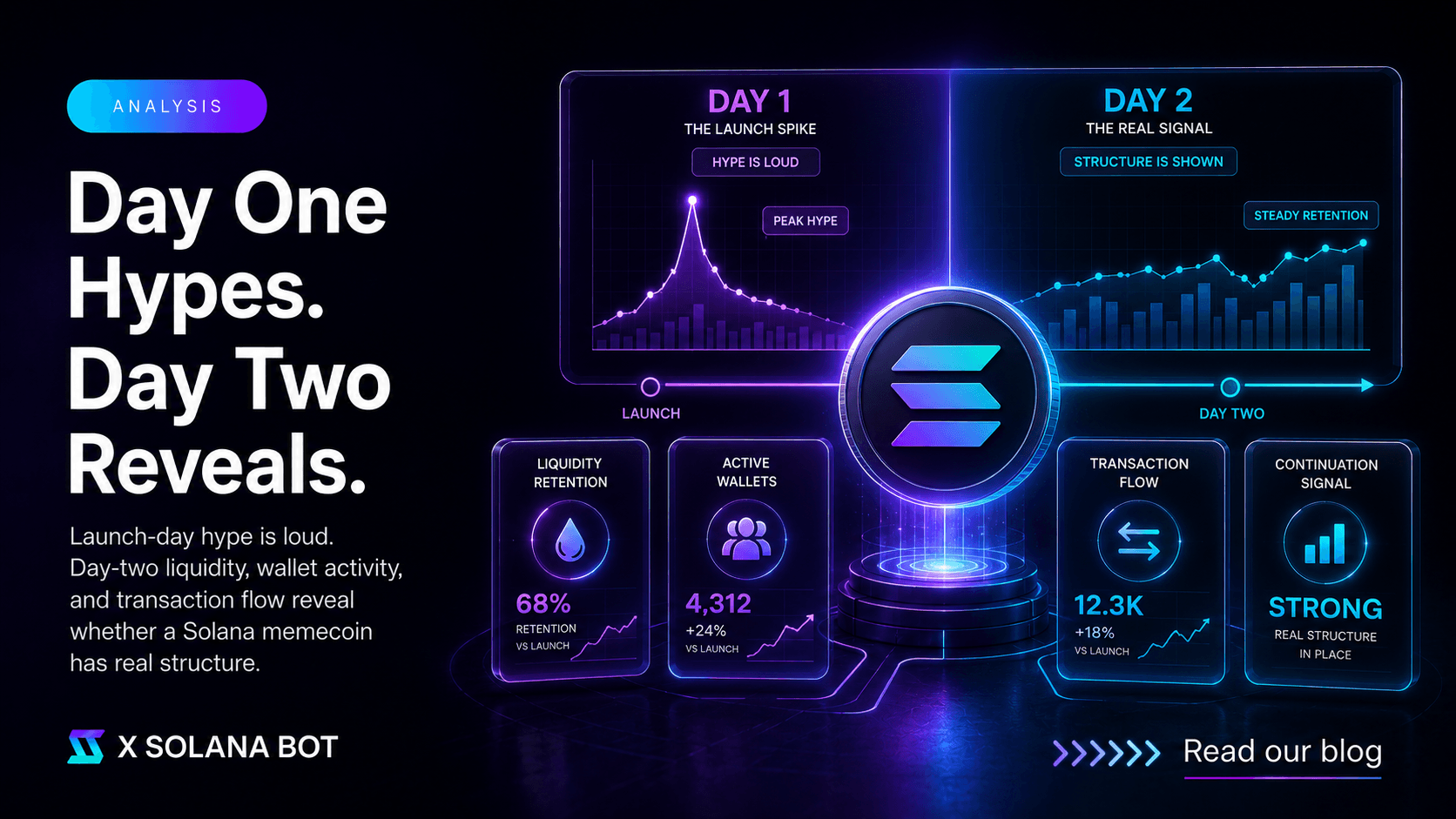
In the Solana memecoin market, the first day often receives the most attention. Traders rush to evaluate launch speed, early volume, first wallets, and initial price action. Yet in many cases, the first day reveals less than people assume. The more useful signal often appears later. Day two can provide a much clearer picture of whether a token is building real market structure or simply benefiting from launch-day excitement.
Why Day One is often misleading
The first day of a memecoin launch is shaped by novelty. A new token enters the market, early participants compete for exposure, and short-term speculation pushes attention toward the chart. During this phase, many visible metrics can appear stronger than they really are.
Volume may look impressive because launch activity is concentrated into a short timeframe. Holder growth may seem healthy because the first wave of curiosity is still active. Price movement may create the impression of momentum even when the market has not yet proven that interest can continue.
This does not mean day one is irrelevant. It simply means that day one is heavily influenced by launch conditions. It reflects the beginning of the story, not necessarily the quality of the market that follows.
For that reason, traders who build decisions only around the launch phase may end up reacting to temporary intensity rather than sustainable participation.
What changes on Day Two
The second day creates a different environment. By then, the initial emotional spike has already passed. The token is no longer being judged only by novelty. It has to operate under more natural conditions.
On day two, several important pressures begin to appear at the same time. Early buyers may start taking profit. Momentum traders who were only interested in the first move begin rotating elsewhere. The wider market becomes less reactive and more selective. In other words, the token has to start functioning without the support of pure launch adrenaline.
This transition matters because it forces the market to reveal whether there is continued interest behind the token. Some projects hold up reasonably well. Others lose activity almost immediately. The difference is often more informative than anything visible during the opening wave.
Day Two as a test of continuation
One of the most important analytical questions in memecoin trading is not whether a token moved, but whether that move can continue in some form. Continuation does not necessarily mean the price must rise aggressively. It means the market still shows signs of life after the first event-driven phase ends.
A token that remains active on day two may continue attracting wallets, maintain stable liquidity, and show ongoing transaction flow even if the price becomes less explosive. That type of behavior suggests the launch produced more than a short-lived spike.
By contrast, a token that loses activity immediately after the launch often reveals a weaker structure. Volume drops sharply, attention disappears, and transactions become sporadic. In those cases, day one created visibility, but day two exposed fragility.
This is why continuation is so important. It turns a launch from an isolated event into the beginning of a market process.
The difference between launch demand and sustained demand
Launch demand is often impulsive. Traders buy because the token is new, because speed creates urgency, or because they believe they need to act before others do. This kind of demand can create dramatic early movement, but it is unstable by nature.
Sustained demand behaves differently. It does not depend entirely on the emotional pressure of being first. Instead, it continues after the market has had time to process the initial opportunity. Sustained demand is visible when wallets still enter after the first wave, when trading activity remains consistent, and when participation does not collapse once launch incentives fade.
The distinction is important because many memecoins can generate launch demand. Far fewer can generate sustained demand.
Day two is where that distinction becomes easier to observe.
What traders should evaluate on Day Two
A serious day-two analysis should go beyond price alone. Price can remain useful, but it does not tell the whole story. What matters more is how the token behaves when the easiest attention has already been used up.
A strong day-two profile often includes several related signs. Liquidity may remain relatively stable rather than collapsing after the first sell pressure. Transaction activity may slow from launch pace, but continue in a meaningful way. New wallets may still appear, even if growth becomes more gradual. Holders may not exit in panic, and the token may show some ability to absorb selling without losing all structure.
A weak day-two profile looks different. Liquidity becomes thin, activity disappears, and the chart starts moving more from absence of participation than from real market conviction. The market does not necessarily “crash” in every case; sometimes it simply fades. That fading can be just as important a signal as a sudden collapse.
Why Day Two improves risk evaluation
Risk looks different once the first 24 hours are over. During launch, nearly everything feels urgent. Traders are often willing to ignore uncertainty because they fear missing out on momentum. This can make even poor setups look acceptable in the short term.
Day two creates distance. It allows more context to emerge. A token that still functions under less emotional conditions may deserve closer attention. A token that cannot survive beyond the launch window may be carrying more risk than its first chart suggested.
This does not mean every day-two survivor becomes a good trade, and it does not mean every token that struggles on day two is automatically worthless. The value lies in comparative analysis. When traders evaluate many new launches over time, day-two behavior can become one of the clearest separators between temporary visibility and healthier structure.
Why this matters for analytical tools
For a platform such as XSolanaBot, day-two behavior can become an important layer of token intelligence. Most tools focus on early discovery, and that is useful. However, a deeper analytical system should also preserve what happens after discovery.
Tracking how a token behaves on the second day helps create a more complete profile. Instead of only asking whether a token launched strongly, the platform can ask whether it retained enough activity to remain relevant. It can compare launch-day signals with day-two performance and identify which early patterns are more likely to survive.
This transforms the analysis from event detection into behavioral evaluation.
A strong memecoin analytics platform should not only help traders find new tokens. It should help them understand which ones continue to matter once the first rush is over.
Final thoughts
In Solana memecoin trading, the first day is loud. It creates the excitement, the screenshots, the hype, and the urgency that pull the market in.
The second day is quieter.
And precisely because it is quieter, it is often more revealing.
That is when the market begins to answer harder questions. Did the token attract only launch-driven speculation, or is there still enough participation to keep it alive? Is the structure holding, or is the activity fading once novelty disappears? Is the market still interested when being early is no longer the main story?
For traders, these questions matter.
Because launch success can be temporary.
What happens after the launch is often where the real analysis begins.