
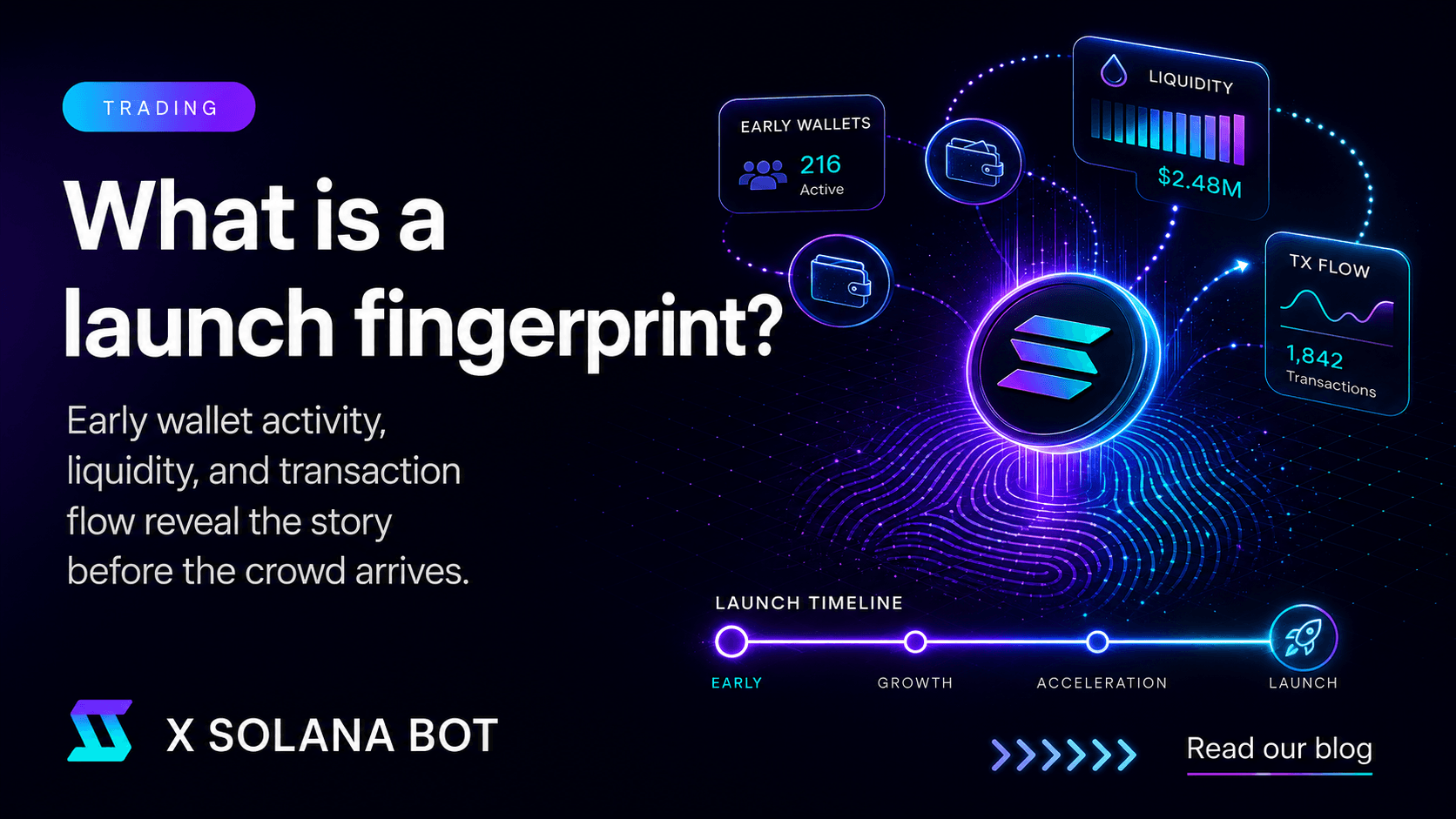
In the Solana memecoin market, the first moments after a token launches can reveal more than many traders realize. Before a token becomes viral, before the chart attracts attention, and before social media begins discussing it, the market already creates a behavioral pattern. This early pattern can be understood as a launch fingerprint — a unique combination of wallet activity, liquidity behavior, transaction flow, and early participation.
Why the launch phase matters
The Solana memecoin ecosystem moves extremely quickly. New tokens appear constantly, and most of them never develop into meaningful opportunities. For traders and analysts, this creates a major challenge: it is not enough to know that a token has launched. The important question is how the token behaves immediately after launch.
The launch phase is valuable because it shows the first real interaction between the token and the market. Some tokens create a short burst of activity and then disappear. Others begin forming a more consistent structure, even before they receive wider attention. This difference is often difficult to see from price alone, but it becomes clearer when the early behavior is analyzed in context.
A launch fingerprint is not a single metric. It is a pattern. It combines several early signals that help explain whether a token is gaining real participation or only producing temporary noise.
The limits of looking only at price
Most traders start with the chart. They look for a fast move, a breakout, or a sudden increase in volume. This approach is understandable, but it is also incomplete.
Price shows the result of activity, not the full structure behind it. A token can move quickly because of a small number of aggressive buys. It can also show volume without healthy participation. In early memecoin trading, price can create the illusion of momentum before the market has actually proven anything.
This is why the launch fingerprint is useful. It shifts attention away from the surface-level move and toward the behavior that creates it. Instead of asking only whether the token is moving, traders can ask how that movement is being formed.
Wallet behavior as an early signal
One of the most important parts of a launch fingerprint is wallet behavior. Early wallet activity can show whether participation is broadening or concentrated within a small group.
If only a limited number of wallets dominate the early activity, the token may be more fragile. Concentrated behavior can increase the risk of sudden exits, unstable price action, and short-lived momentum. On the other hand, if new wallets continue to appear gradually, it may suggest that interest is expanding beyond the first wave of participants.
The quality of wallet activity matters as much as the quantity. A token does not become stronger simply because transactions exist. The more important question is whether participation develops in a way that looks consistent and sustainable.
Liquidity behavior during the first stage
Liquidity is another key part of the launch fingerprint. Many traders treat liquidity as a simple number, but early liquidity behavior is more nuanced.
A token may launch with visible liquidity, but that does not automatically mean it has a healthy structure. The real question is whether liquidity remains stable, grows naturally, or becomes unstable after the first wave of activity.
When liquidity supports continued trading, the market has more room to develop. When liquidity is fragile, even small changes in participation can create aggressive price movement. This can make a token look active, but also highly unstable.
In this sense, liquidity should not be viewed only as a safety signal. It should be analyzed as part of the token’s early behavior.
Transaction flow and continuation
The first transactions after launch can reveal whether activity is only a moment or the beginning of a pattern. A short spike in transactions may attract attention, but it does not necessarily indicate strength.
Continuation is more important.
If transaction flow remains active after the first minutes, the token may be developing a stronger foundation. If activity disappears almost immediately, the launch may have been driven by short-term speculation rather than real interest.
This is where many early mistakes happen. Traders see the first burst of activity and assume that momentum is forming. But without continuation, that movement can fade quickly.
A useful launch fingerprint therefore looks beyond the first spike and focuses on whether the market keeps interacting with the token after the initial excitement.
Why early behavior can reveal market quality
Every new token begins with uncertainty. No metric can fully predict the future, especially in a speculative environment like memecoins. However, early behavior can still reveal important information about market quality.
A token with chaotic, concentrated, and short-lived activity behaves differently from a token that shows gradual wallet expansion, stable liquidity, and consistent transactions. These patterns do not guarantee success, but they help separate random noise from more structured development.
This is especially important on Solana, where speed can pressure traders into emotional decisions. The faster the market moves, the more valuable structured analysis becomes.
How analytical tools support launch analysis
Manually tracking launch behavior is difficult. The number of new tokens is high, and the window for early analysis is short. By the time a trader manually checks several data points, the market may already have changed.
This is where analytical tools create practical value. A tool designed for Solana memecoin analysis can help monitor early wallet behavior, liquidity changes, transaction patterns, and token activity in one place. This allows traders to evaluate the launch fingerprint more efficiently and avoid relying only on visible price movement.
The purpose is not to remove risk. The purpose is to improve clarity.
Better data helps traders make more structured decisions in a market where emotion and speed often dominate.
Final thoughts
The first moments after a Solana memecoin launches are more important than they may seem. Before the token becomes popular, before the chart attracts attention, and before social media creates a narrative, the market already begins leaving signals.
That early behavior is the token’s launch fingerprint.
It shows how wallets interact, how liquidity behaves, how transactions develop, and whether activity continues beyond the first burst. For traders, this information can be valuable because it reveals structure before the crowd reacts.
In a market where most tokens disappear quickly, the ability to read early behavior is a real advantage.
Because in Solana memecoin trading, the chart shows what happened.
The launch fingerprint helps explain how it started.