
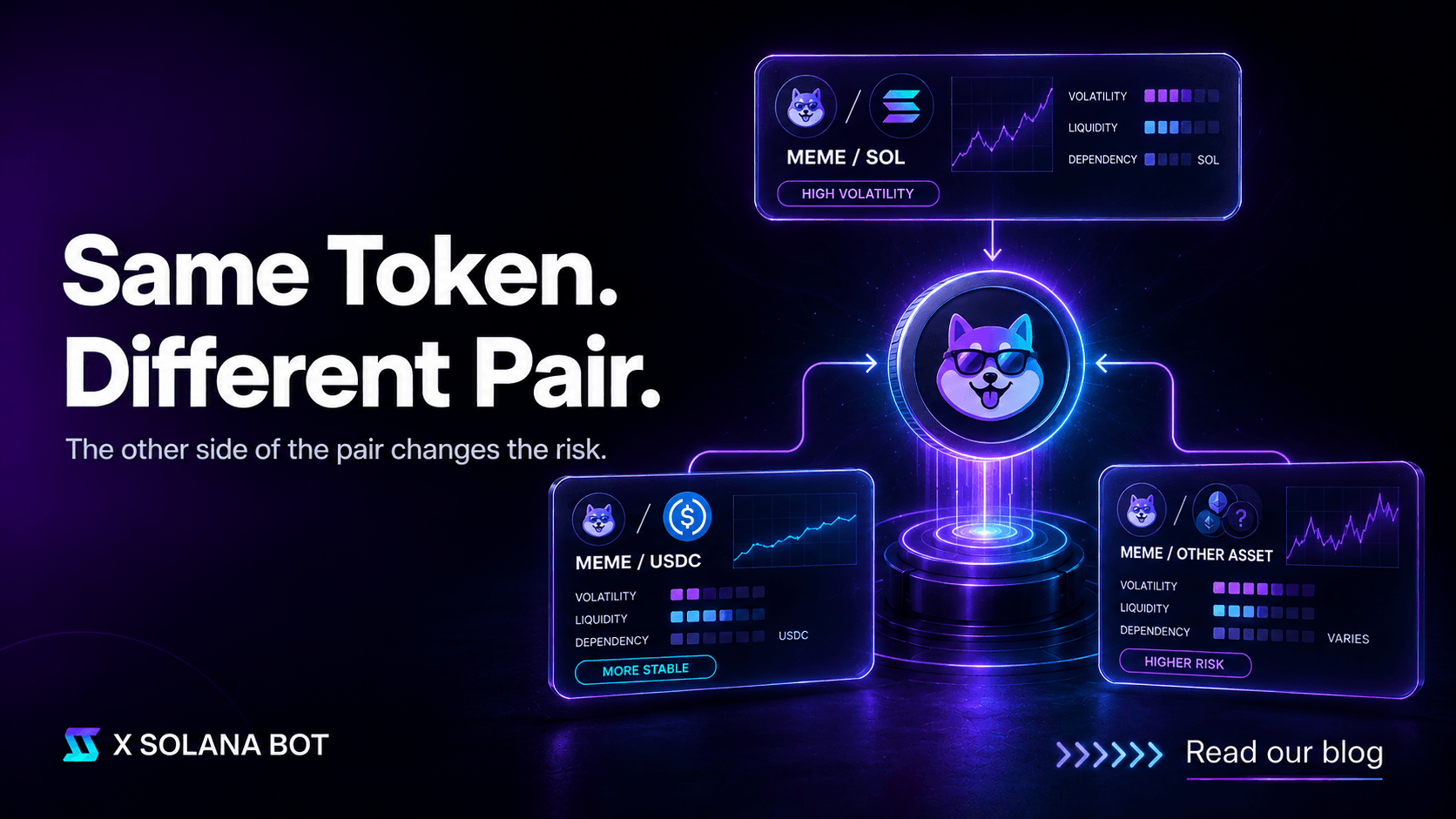
Solana memecoin analysis usually begins with the token itself. Traders examine volume, liquidity, holder concentration, wallet behaviour and transaction activity before deciding whether a market deserves further attention. But as token-launching infrastructure becomes more flexible, another variable is becoming increasingly important: the asset on the other side of the trading pair. A memecoin paired with SOL does not necessarily create the same market structure as one paired with USDC, another cryptocurrency or a tokenized asset. Understanding the paired asset adds an additional layer of context to liquidity, price behaviour and risk.
A memecoin never trades completely on its own
Every market is ultimately a relationship between two assets.
When traders look at a token price, they are not observing an independent number. They are observing how much of another asset the market is willing to exchange for that token.
This distinction is easy to ignore when the paired asset is familiar.
A trader looking at a MEME/SOL pair may mentally focus almost entirely on the memecoin. SOL becomes background infrastructure rather than part of the analytical decision.
But economically, both assets matter.
If the paired asset changes in value, liquidity or accessibility, the market surrounding the memecoin changes as well.
This means that serious token analysis should consider two separate layers: the characteristics of the token being investigated and the characteristics of the asset used to price and trade it.
Custom pairs make this distinction more important
The development of more flexible pairing options on Solana makes pair analysis increasingly relevant.
Tokens launched through Pump can now use various supported assets as the paired asset against which a coin is launched, priced or traded. These supported assets are not limited to the traditional SOL pair.
The available universe can include stablecoins, protocol tokens, wrapped assets, tokenized real-world assets and other cryptocurrencies.
For traders, this creates more flexibility.
For analytics, it creates more complexity.
A scanner can no longer assume that every newly launched memecoin operates under roughly the same quote-asset conditions.
Before comparing two tokens, the system needs to understand what each token is actually paired against.
SOL and USDC create different market behaviour
The difference becomes obvious when comparing two of the simplest possible pairings.
Consider one memecoin paired with SOL and another paired with USDC.
USDC is designed to maintain a relatively stable relationship with the U.S. dollar. This means that, under normal conditions, changes in the dollar value of the memecoin are driven primarily by changes in the memecoin side of the pair.
SOL behaves differently.
SOL itself is a volatile crypto asset.
Suppose a memecoin remains unchanged relative to SOL while SOL appreciates significantly against the dollar. The dollar value of the memecoin can increase even though its relative performance against SOL has not changed.
The reverse can also happen.
A token can perform reasonably well against SOL while its dollar-denominated chart appears weaker because SOL itself is falling.
This is why the unit in which performance is measured matters.
Price is always relative.
A strong chart can sometimes be partly a strong pair asset
This creates an analytical problem similar to the distinction between token alpha and market beta.
A trader sees the dollar value of a memecoin rising and assumes that demand for the token is increasing.
That may be true.
But part of the movement can originate elsewhere.
If the paired asset appreciates strongly, the dollar-denominated value of the entire pool can change even if the relative relationship between the two assets remains much more stable.
This makes comparative analysis important.
How is the token performing against its paired asset?
How is the paired asset performing against the dollar?
How much of the apparent move comes from token-specific demand?
These questions provide considerably more information than one price chart alone.
Pair volatility changes the risk of the market
When both sides of a trading pair are volatile, traders effectively deal with two moving variables.
A stablecoin pair removes much of that second layer during normal market conditions.
A volatile pair does not.
If both assets move simultaneously, outcomes can become less intuitive.
The memecoin can appreciate relative to the paired token while still losing value in another denomination. Alternatively, it can appear stable against one asset while experiencing significant economic movement when measured in dollars.
This is especially important for short-term traders who may think primarily in a single reference currency.
Understanding the volatility of the paired asset helps explain why apparent token performance and actual portfolio performance are not always identical.
Liquidity should also be evaluated on both sides
Liquidity analysis is normally focused on the size of the pool.
That is necessary, but it is not sufficient.
The quality of a liquidity pool also depends on the assets inside it.
A deep pool involving widely traded assets operates differently from a pool dependent on a much smaller or less liquid paired token.
Suppose two memecoins each have liquidity worth approximately the same amount.
The first is paired against an asset with deep external markets across the Solana ecosystem.
The second uses an asset whose liquidity is itself concentrated within several relatively small pools.
The nominal liquidity numbers may look similar.
The liquidity dependencies are not.
A useful analytical system should therefore understand not only how much liquidity exists, but also the market quality of the asset providing the other side of that liquidity.
Pair concentration creates another dependency
A paired asset can introduce concentration risk independent of the memecoin being analysed.
The memecoin itself may have relatively healthy holder distribution.
But what about the token on the other side?
If ownership or liquidity of the paired asset is highly concentrated, a major movement there can affect the entire market.
This produces a dependency that is invisible when traders examine only the memecoin’s holder table.
The market may effectively inherit some of the structural characteristics of its pair.
A sophisticated risk model should therefore treat pair-asset concentration as a separate variable.
Pair assets can introduce issuer and infrastructure risk
Not every supported paired asset is purely decentralized.
Some assets may have issuers. Others may depend on cross-chain infrastructure, custodians, tokenization providers or other external systems.
That creates another category of risk.
A memecoin can operate perfectly normally while something changes at the level of the paired asset.
An issuer can alter terms.
Infrastructure can experience problems.
An asset can become restricted or frozen.
A bridge or listing provider can encounter technical or operational issues.
In those situations, the problem does not originate from the memecoin itself, yet the memecoin market can still be affected because its liquidity depends on the paired asset.
This is a critical distinction.
Token risk and pair risk are separate risks.
What happens if a paired asset becomes unavailable?
This question is particularly important because liquidity pools are functional systems, not abstract numbers.
If an asset forming one side of the pool becomes frozen, restricted or unavailable, normal trading conditions may no longer exist.
The token on the opposite side does not need to contain any technical problem of its own.
Its market can still become difficult or impossible to use because the pool depends on an affected asset.
For analytics, this suggests the need for a pair-status layer.
A scanner should ideally understand whether the paired asset is active, supported and functioning normally rather than assuming that historical pool liquidity is always accessible.
Fees and rewards also inherit the paired asset
The paired asset can influence more than price and liquidity.
Within Pump’s custom-pair environment, trading fees, creator fees and cashback rewards are collected and paid in the asset with which the coin is paired.
That means the economics surrounding the token are partly denominated in the pair asset.
If a creator or holder earns fees from activity, the economic value of those rewards can change together with the paired asset.
This introduces another variable into incentive analysis.
Ten units of one paired asset can behave very differently from ten units of another.
For analysts studying incentives, creator behaviour or holder rewards, knowing the fee amount is therefore not enough.
The denomination matters.
The same reward rate can have different economic effects
Imagine two token ecosystems offering economically similar reward structures.
One pays rewards in a relatively stable paired asset.
The other distributes rewards in a highly volatile asset.
The nominal reward mechanism may look similar, but participant behaviour can differ.
In the volatile pair, users are exposed not only to the reward quantity but also to changes in the value of the reward asset.
This can influence holding decisions, creator incentives and realised economic outcomes.
Once again, context changes the interpretation of the metric.
Pair correlation can amplify or reduce volatility
Another useful analytical concept is correlation.
If the memecoin and its paired asset tend to respond to similar market conditions, some price movements may reinforce each other when measured against an external reference such as the U.S. dollar.
If they behave very differently, the relationship can become more complex.
This does not require traders to calculate sophisticated correlation models for every new memecoin.
Even a basic understanding of the paired asset’s market behaviour can improve interpretation.
Is the pair asset strongly connected to the broader crypto market?
Is it designed to remain stable?
Does it follow another underlying asset?
Is it itself a speculative token?
These distinctions matter.
Custom pairs make token comparison harder
The increasing diversity of pair assets also creates a challenge when ranking tokens.
Imagine a scanner comparing two memecoins solely according to:
volume,
liquidity,
price change,
and transactions.
Token A trades against SOL.
Token B trades against another volatile token.
Comparing the raw metrics directly can produce misleading conclusions because the market structures differ.
A more advanced system should normalize or contextualize those metrics according to the pair.
Volume should identify its denomination.
Liquidity should account for pair quality.
Price performance should distinguish token movement from pair-asset movement.
Fees should record the asset in which they are generated.
Only then do the numbers become genuinely comparable.
Pair-asset analysis creates a new layer for XSolanaBot
For XSolanaBot, custom pairs create an opportunity to extend token intelligence beyond the token contract itself.
A token profile could include a dedicated Pair Asset section.
This could identify the paired asset, its category, liquidity, volatility, current status and external dependencies.
The analytics layer could then combine that information with conventional token metrics.
Instead of seeing:
Liquidity: $250,000
the trader receives context explaining what actually forms that liquidity.
Instead of seeing:
Price: +18%
the trader could understand how much the paired asset moved during the same period.
Instead of seeing:
Creator Rewards: X
the system could identify what asset those rewards are denominated in.
This is a substantially richer model.
Risk belongs to the entire trading pair
Crypto traders frequently evaluate token risk as though the token exists independently.
Smart-contract risk.
Holder concentration.
Liquidity.
Developer behaviour.
Wallet clusters.
All of these remain important.
But a trading pair is a system composed of two assets.
Weakness on either side can affect the market.
That means a complete risk assessment should ask:
What is the token?
And:
What is it paired with?
Final thoughts
Custom pairs create more flexibility for Solana token markets.
They also create another dimension of analysis.
A memecoin paired against SOL, USDC or another digital asset should not automatically be evaluated under identical assumptions.
The paired asset can influence price interpretation, volatility, liquidity, incentives and operational risk.
This does not make custom pairs inherently more dangerous.
It makes context more important.
The token is one half of the market.
The pair asset is the other.
And if analytics ignores one side of the trade, it ignores part of the risk.
The next time a new Solana memecoin looks interesting, do not stop after analysing the token.
Ask one more question:
What exactly is on the other side of the pair?