
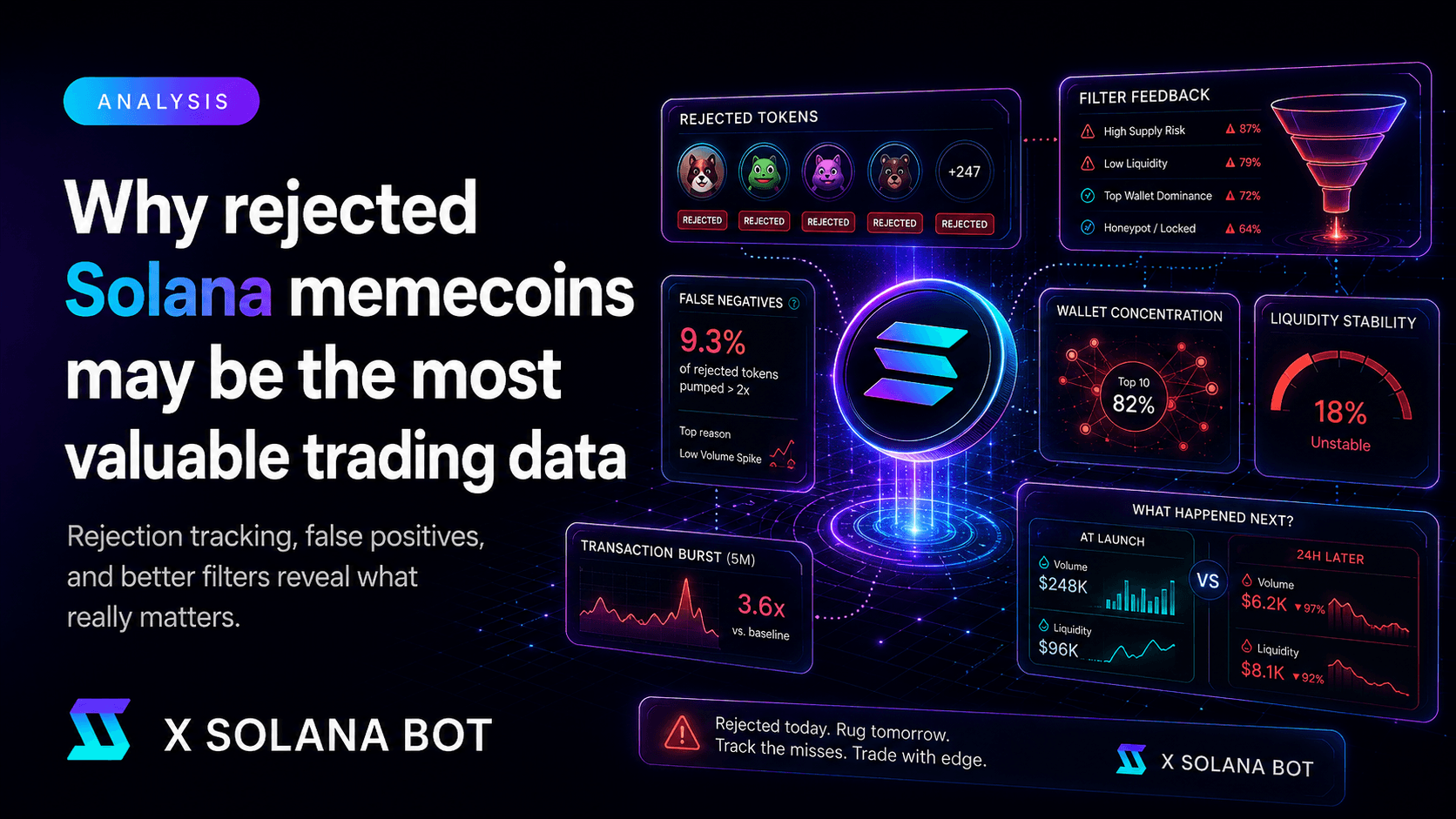
Most Solana memecoin analysis focuses on successful tokens. Traders study the coins that pumped, the wallets that entered early and the signals that appeared before a major move. But this approach creates a serious blind spot. If an analytical system only studies what worked, it cannot properly evaluate whether its filters are actually effective. The tokens that were rejected — and what happened to them afterward — may provide some of the most valuable data in the entire decision-making process.
The hidden problem with studying only successful memecoins
The crypto market is full of retrospective analysis. After a Solana memecoin performs well, it becomes easy to identify the signals that supposedly predicted its success. Analysts point to early wallet activity, increasing liquidity, transaction growth or the appearance of a strong narrative.
The problem is that this analysis begins with a known outcome.
The token already succeeded.
Once the result is visible, almost any earlier signal can appear more important than it actually was. This creates survivorship bias: the market remembers the tokens that worked and forgets the thousands that displayed similar characteristics before disappearing.
A genuinely useful analytical process cannot study winners in isolation. It must compare them with the tokens that looked promising but failed, as well as those that were filtered out before they ever became serious candidates.
Without that comparison, it is difficult to know whether a signal is meaningful or simply common.
A rejected token is not the end of the analysis
Imagine that a new Solana token enters an analytical system. It initially appears interesting, but several conditions raise concerns. Holder concentration may be too high. Liquidity may be unstable. Transaction activity may be concentrated within a short period. Wallet participation may fail to expand after the initial launch.
The token is rejected.
For many systems, the analysis ends there.
That is a mistake.
The moment a token is rejected creates a new analytical opportunity. The system can continue observing the token and ask a more important question: what happened afterward?
Did the token lose half of its value?
Did liquidity disappear?
Did transaction activity collapse?
Did the largest holders begin selling?
Or did the token recover, build stronger participation and become a meaningful opportunity that the system incorrectly dismissed?
The answer provides feedback. Without that feedback, a filter is only a rule. With feedback, it becomes part of a learning process.
Why negative data matters
Positive signals are easy to value. A token passes the filters, performs well and appears to confirm the analytical model.
Negative data is more complicated, but often more useful.
When a system rejects a token and that token later collapses, the rejection provides evidence that the filtering logic may have identified genuine risk. When a rejected token later succeeds, the result reveals a potential weakness in the analytical process.
Both outcomes are valuable.
This is fundamentally different from simply counting winners and losers. The objective is to understand the relationship between a decision and the reason behind that decision.
A filter based on holder concentration should be evaluated by observing what happens to tokens rejected for concentration risk. A liquidity filter should be tested against the future behavior of tokens that failed liquidity requirements. The same principle applies to transaction patterns, wallet activity and other behavioral signals.
Over time, this creates a much more precise understanding of which filters provide real value.
The difference between missed opportunities and correct rejections
Every trader remembers the token they did not buy before it exploded.
This creates a dangerous psychological problem.
One missed opportunity can make a trader question an entire strategy. Filters become looser. Risk tolerance increases. The next borderline token is accepted because the trader does not want to “miss another one”.
But a missed winner does not automatically mean that the original decision was wrong.
A good risk filter will sometimes reject successful tokens. That is unavoidable. The objective of a filtering system is not to capture every possible winner. It is to improve the quality of the overall opportunity set while controlling exposure to weak or dangerous launches.
This is why rejected tokens need to be analysed as a group, not remembered individually.
One rejected token that later performs well may feel painful. But if the same filter also excluded dozens of tokens that subsequently collapsed, the broader outcome may still justify the decision.
The correct question is therefore not:
“Did one rejected token pump?”
The better question is:
“What happened to all tokens rejected for the same reason?”
That is where useful analysis begins.
Building a rejection history
A sophisticated memecoin analytical system should maintain a history of rejected opportunities. Each rejection should preserve the market conditions that existed when the decision was made.
The token itself matters, but the reason for rejection matters more.
Was the supply too concentrated?
Did liquidity fail to develop?
Was transaction activity dominated by a short burst?
Did wallet participation stop expanding?
Was the token already losing momentum when the system detected it?
When this information is stored, the token can be evaluated again after a defined period. The system can then compare the original decision with the later market outcome.
This creates a form of analytical memory.
Instead of treating every new token as an isolated event, the system begins building a database of previous decisions, conditions and consequences.
For a market as fast and repetitive as Solana memecoins, that history can become extremely valuable.
What false positives and false negatives reveal
No analytical model is perfect. The objective is not to eliminate mistakes completely, but to understand them.
A false positive occurs when a token appears attractive but later performs poorly. A false negative happens when a token is rejected but later becomes successful.
Both types of error expose different weaknesses.
Too many false positives may suggest that the system is too permissive. It may place excessive importance on early activity without properly measuring continuation, concentration or liquidity quality.
Too many false negatives may indicate the opposite. The filters may be too restrictive, rejecting unusual but potentially strong launch patterns simply because they do not resemble historical winners.
This is where rejected-token analysis becomes more than risk management. It becomes a method for improving the quality of the analytical system itself.
The objective is not to create a perfect filter.
The objective is to create a filter that can be evaluated.
Why this matters more in the Solana memecoin market
Traditional financial markets often provide long histories, established assets and relatively stable analytical frameworks. New Solana memecoins operate in a completely different environment.
The history is short.
The number of new launches is enormous.
Market behaviour changes quickly.
A pattern that worked several months ago may become less useful once more traders, bots and token creators begin reacting to it.
This means static rules can become outdated.
A system that evaluates both accepted and rejected tokens has a better chance of identifying when its own logic stops working. If tokens rejected for a specific reason begin performing differently than before, the change itself becomes information.
The market is not only producing signals about tokens.
It is producing signals about the quality of the analytical model.
From token scanner to decision intelligence
There is an important difference between displaying data and understanding decisions.
A basic token scanner shows what exists.
A more advanced analytical tool helps determine what deserves attention.
The next level goes further. It evaluates whether previous decisions were correct and learns from the outcomes.
This is where negative data becomes especially powerful.
Tracking rejected tokens can reveal which risk indicators are consistently useful, which conditions are becoming outdated and which unusual patterns deserve further investigation.
For a platform such as XSolanaBot, this is a natural direction for intelligent memecoin analysis. The goal is not simply to generate more token alerts. More alerts usually create more noise.
The goal is to improve the quality of selection.
The best signal may be a correct “no”
Crypto culture celebrates action. Finding the next token. Entering early. Catching the move.
But mature analysis also needs to value rejection.
A correct decision not to enter a weak token may never appear on a profit chart. It does not create an exciting screenshot. It is difficult to share on social media.
Yet protecting capital from poor opportunities is part of performance.
A system that correctly identifies what should be ignored can provide just as much value as one that discovers what deserves attention.
This changes the definition of a good analytical tool.
The question is no longer simply:
“How many winners did it find?”
A better question is:
“How much bad risk did it help eliminate?”
What this changes for Solana memecoin analysis
The future of memecoin analytics may depend less on finding one perfect signal and more on building systems that understand their own decisions.
That requires analysing winners, losers, accepted opportunities and rejected ones together.
A token that passes every filter provides data.
A token that fails every filter provides data.
A token that was rejected and later succeeded may provide even more.
Because the purpose of analysis is not to prove that a system is always right. The purpose is to discover where it is right, where it is wrong and why.
In a market where thousands of tokens compete for attention, better selection may become more valuable than more discovery.
The most intelligent question may no longer be:
“What should I buy?”
It may be:
“What did I reject — and what happened next?”