
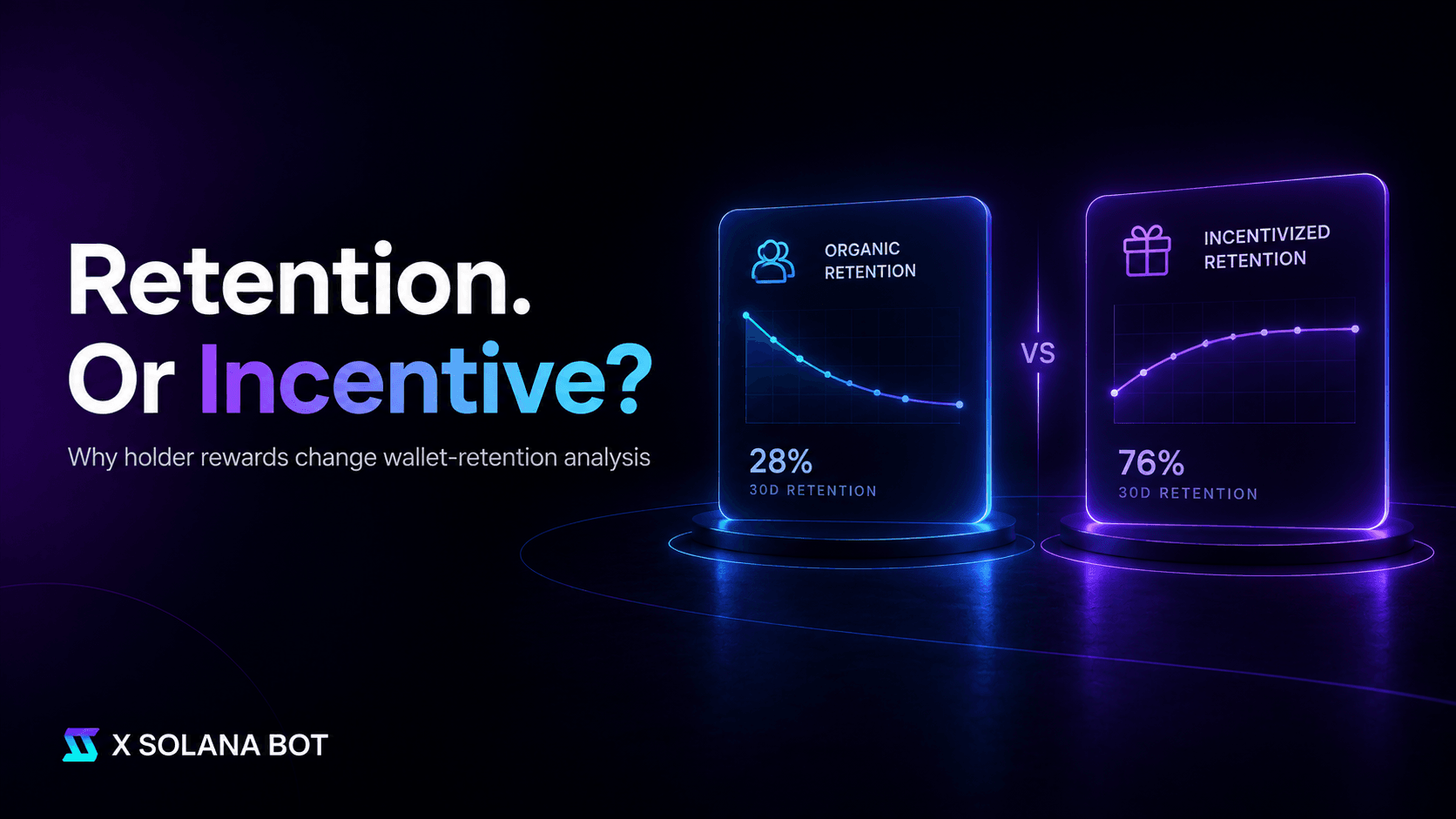
Wallet retention has become an increasingly useful metric for analysing Solana memecoins. A token that attracts participants at launch and keeps them involved afterwards can appear structurally stronger than one whose wallet activity disappears immediately. The introduction of Holder Rewards on Pump.fun, however, adds a new variable to this interpretation. When holding a token can itself generate an economic reward, analysts need to understand not only how long wallets remain involved, but also why they remain.
Holder Rewards change the economics of holding a memecoin
Pump.fun now allows coins to be created using a Holder Rewards model. For these tokens, the creator fee charged on trades is not paid to the creator wallet. Instead, it is set aside for holders and distributed to them by Pump.fun.
From a market-analysis perspective, this is an important change because incentives affect behaviour.
Until now, a trader observing high wallet retention could reasonably interpret it as one piece of evidence that participants continued to believe in the token, remained engaged with its narrative or expected further market activity.
That interpretation was never perfect. Traders can hold for many reasons. But explicit holder rewards add a clearly identifiable economic reason to remain exposed to the token.
Retention therefore remains useful, but its meaning becomes more complex.
Retention and conviction are not the same metric
Imagine two Solana memecoins with the same seven-day retention rate.
In both cases, 65% of first-day wallets still hold or interact with the token one week later.
The first token provides no direct reward for remaining a holder. Its participants may be staying because of market expectations, community participation, ongoing trading opportunities or longer-term conviction.
The second token distributes trading-fee rewards to holders.
Its participants may share exactly the same motivations, but part of the wallet base may also remain because exiting means giving up potential rewards.
Both tokens show 65% retention.
The number is identical.
The behavioural context is not.
This illustrates one of the central principles of modern on-chain analysis: a metric should not be interpreted independently of the mechanism that can influence it.
Incentivized retention is not automatically low-quality retention
The presence of an incentive should not be treated as evidence that the activity is artificial or undesirable.
Financial incentives influence behaviour across almost every market. Interest attracts capital to currencies and fixed-income assets. Dividends influence equity ownership. Staking rewards affect crypto holding periods.
Holder Rewards operate according to the same general principle: the economic structure of an asset changes the decision faced by participants.
In some cases, this mechanism may help a token develop a more stable holder base. Participants may remain involved longer, communities may have more time to develop and selling pressure may change because immediate exits become relatively less attractive.
The analytical objective is therefore not to remove incentivized activity from the dataset.
It is to interpret it correctly.
The more useful question is: why did the wallet stay?
A conventional retention dashboard answers quantitative questions.
How many wallets remained after 24 hours?
How many returned after three days?
What percentage of initial participants remain after a week?
Those metrics are still valuable, but Holder Rewards introduce a second analytical layer.
Why are those wallets still present?
Blockchain data cannot directly reveal the motivation inside a trader's head, but behaviour around the retained position can provide additional context.
A wallet that simply holds the asset and collects rewards behaves differently from one that repeatedly returns to buy, sell or otherwise participate in the market.
This creates an important distinction between passive retention and active retention.
Passive retention versus active retention
Passive retention occurs when a wallet continues holding the token but generates little additional market activity.
Active retention occurs when returning wallets continue to transact after the initial purchase.
Neither behaviour should automatically be considered good or bad. A healthy long-term holder does not need to trade every day.
However, the distinction becomes analytically useful when explicit holding rewards exist.
Suppose wallet retention remains very high while transaction activity falls continuously, new-wallet acquisition weakens and liquidity begins to contract. The token technically retains many holders, but the underlying market may be becoming less active.
Now consider another Holder Rewards token where retained wallets continue transacting, new participants continue entering and liquidity remains relatively stable.
The retention rate might be identical, but the second token is demonstrating a much broader form of continued participation.
A single percentage cannot show this difference.
New-wallet acquisition provides another important signal
Retention describes how well a token keeps previous participants.
It says nothing about whether the market continues attracting new ones.
This distinction matters for incentivized tokens because a reward mechanism may be very effective at reducing exits from the existing holder base while doing relatively little to generate fresh demand.
A token showing increasing retention and increasing new-wallet acquisition is behaving differently from one whose retention improves while acquisition steadily declines.
Neither observation predicts future price performance, but the combination helps analysts understand whether the market is expanding, stabilising or slowly becoming dependent on an existing group of rewarded holders.
Retention should therefore be analysed alongside acquisition rather than in isolation.
Liquidity provides a market-quality check
Liquidity adds another layer of confirmation.
A token can maintain an impressive number of holders while available trading depth becomes increasingly weak. If most participants become passive, a large retained wallet base does not necessarily translate into a liquid market.
This is why retention quality needs to be evaluated alongside liquidity retention.
Does available liquidity remain stable after the initial launch?
Can the market still absorb normal transactions without excessive price impact?
Does liquidity grow alongside the holder base?
If high wallet retention exists together with healthy liquidity, active transactions and continued wallet acquisition, the signal becomes considerably more informative.
If retention rises while every other measure of market participation weakens, the reward mechanism may be playing a larger role in the observed behaviour.
Reward-adjusted retention creates a better comparison
One potential improvement for memecoin analytics is to stop comparing all tokens against one universal retention baseline.
Holder Rewards coins operate under a different economic model from conventional coins. Comparing them directly can therefore produce misleading conclusions.
A better approach is cohort analysis.
Holder Rewards tokens can be compared with other Holder Rewards tokens launched under similar conditions. Standard tokens can form a separate benchmark.
If a reward-bearing token retains 70% of wallets while comparable Holder Rewards tokens average 45%, its retention is genuinely unusual even after accounting for the incentive.
If the entire category averages approximately 68%, the same 70% figure becomes much less remarkable.
The raw number has not changed.
Its interpretation has.
This is exactly why contextual analytics matter.
The relationship between trading activity and rewards creates a feedback loop
Holder Rewards also create an interesting connection between trading and holding.
The reward mechanism is funded through the creator fee generated by trades. More trading activity can therefore affect the economics of holding the token.
This creates a potential feedback loop.
Trading produces fees.
Fees support holder rewards.
Rewards may influence holding behaviour.
Holding behaviour can affect available supply, market participation and future trading.
The resulting system is more complex than a conventional holder-retention model.
Analysts therefore need to understand both the current state of the token and the incentive structure shaping participant behaviour.
What happens when the reward becomes less attractive?
One of the most revealing tests may occur when the economic value of the incentive changes.
If trading activity falls, the reward environment may change as well. At that point, analysts can observe whether wallets remain involved even when the incentive becomes less powerful.
Does retention remain stable?
Does active participation continue?
Do new buyers still appear?
Does liquidity remain resilient?
Behaviour under weaker incentives may help separate participants primarily attracted by the reward from those whose involvement extends beyond it.
Again, this is not about deciding which motivation is superior.
It is about understanding the market accurately.
Incentive-aware analytics are becoming necessary
Holder Rewards are part of a wider development in crypto markets.
Token design increasingly includes mechanisms intended to influence participant behaviour: staking rewards, fee sharing, points, rebates, referral incentives and other forms of economic distribution.
As these structures become more sophisticated, simple behavioural metrics become harder to interpret without context.
A wallet remaining active may be evidence of conviction.
It may also be rational optimisation around an incentive.
Frequently, it will be a combination of both.
Analytical systems therefore need to become incentive-aware.
They need to understand the economic rules surrounding the behaviour they measure.
How XSolanaBot can analyse retention more intelligently
For XSolanaBot, the existence of Holder Rewards can become another layer within the token profile.
Instead of displaying retention as one isolated percentage, analysis can incorporate whether the token uses an explicit holder-reward mechanism and evaluate its behaviour accordingly.
A more complete retention profile could combine wallet retention with returning-wallet activity, new-wallet acquisition, transaction persistence, liquidity retention and reward structure.
This would allow users to distinguish between a token that merely keeps wallets and one that keeps an actively participating market.
The objective is not to classify Holder Rewards as positive or negative.
It is to provide enough context for the user to understand what the retention metric actually represents.
Final thoughts
Wallet retention remains a valuable Solana memecoin metric.
But incentives change behaviour.
When holding a token can directly produce rewards, remaining in a position becomes an economic decision as well as a possible expression of conviction.
That means retention analysis needs to evolve.
Do not stop at:
How many wallets stayed?
Ask:
Why did they stay?
Then look at what happened around them.
Did transactions continue?
Did new wallets arrive?
Did liquidity remain healthy?
Did retained wallets remain active?
Because sophisticated analytics do not simply measure behaviour.
They understand the system creating it.